

The Clear Water, Black Stone, and Dark Skies of Kozushima
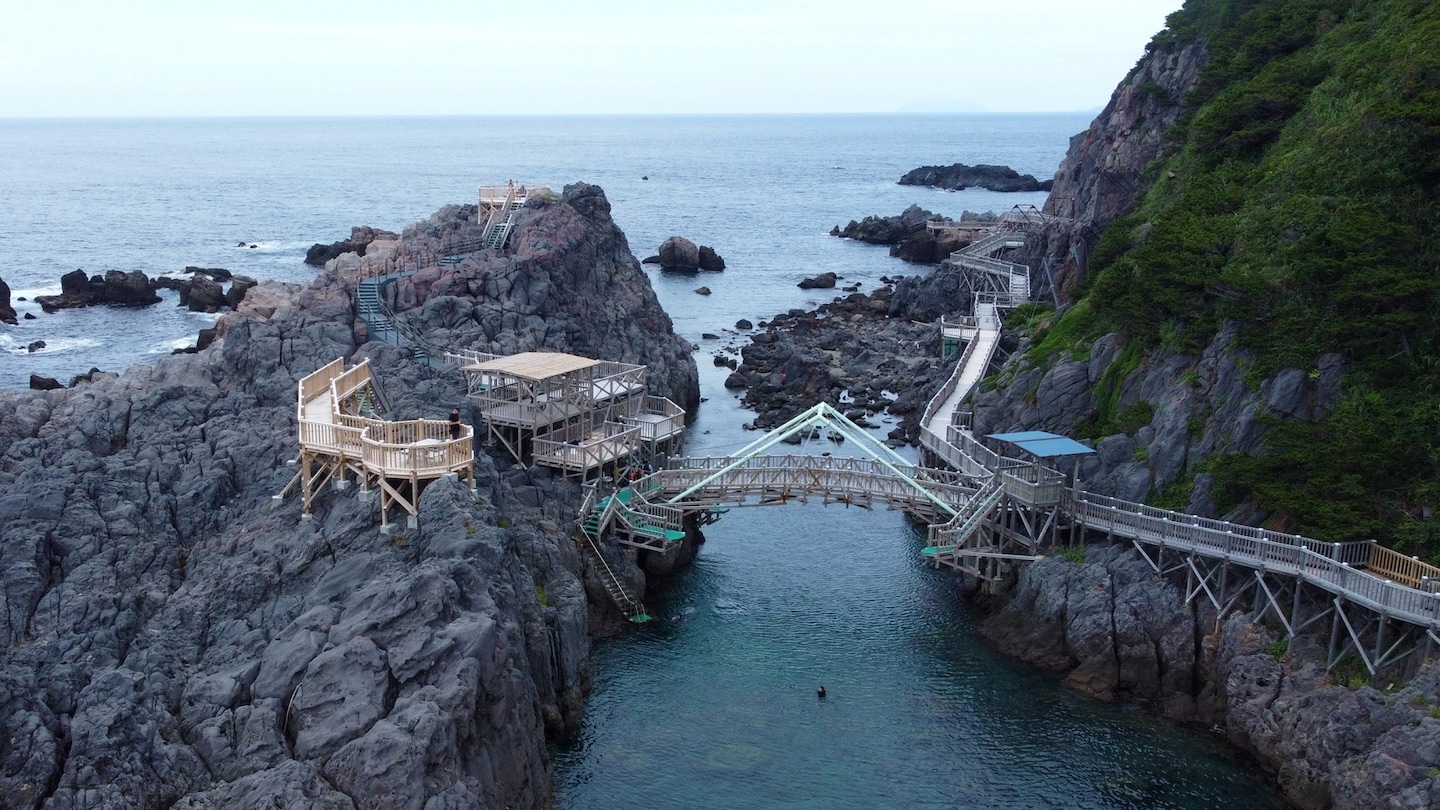
Akasaki Promenade
An unplanned trip to Kozushima is thrown off course by cancelled flights, and a hunt for dark skies is foiled by a full moon. Andrew Lee travels with a toddler in tow, through spring-fed beer, on mosquito-heavy trails on Mt. Tenjo, to find a legend of gods dividing water on a mountain pond.
By Andrew Lee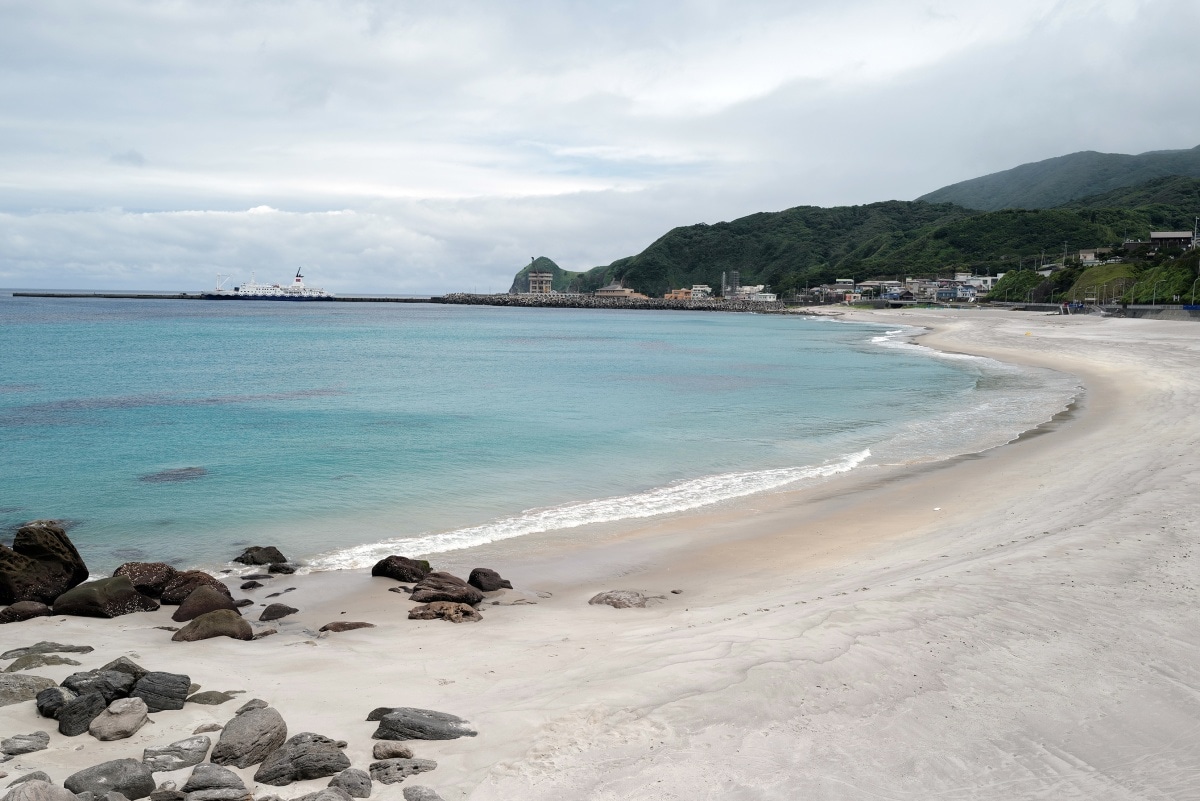
Maehama Beach, Kozushima
The woman coming along the seafront toward us was walking a small poodle the same color as her peroxide blonde hair.
“You went swimming?” she asked in disbelief.
We had. Our clothes were still wet, and our toddler was wrapped in a beach towel. The water at Maehama beach on Kozushima Island was beautifully clear, and my son had squealed with glee as we jumped through the waves breaking onto the white sand. It hadn’t occurred to me that this was in any way odd. The water wasn’t that cold. Perhaps the woman was surprised because it was still only June, and the start of Japan’s beach season was technically two days away, on July 1.
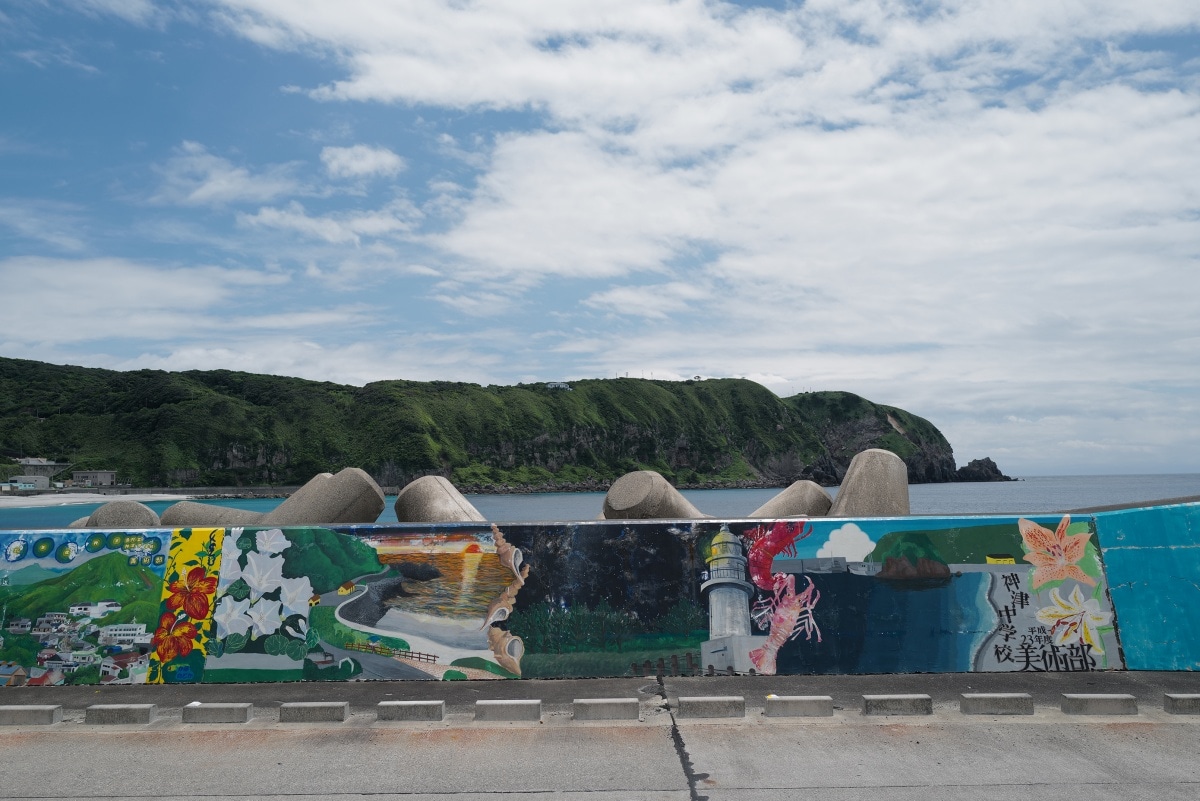
Kozushima port terminal
We were supposed to have flown here. But the night before our early morning flight from Chofu Airport, the airline rang to say it was cancelled due to high winds. We had a minshuku (guest house) booked already and would almost certainly be charged for the night if we failed to turn up, especially as the boats were still running. We frantically looked into taking the overnight ferry, but with a sleepy toddler in tow we would never make it. Instead we took the jet boat in the morning, and arrived on Kozushima only about two hours later than the plane.
This is one of the great things about visiting the island: It's very easy to get to, weather permitting. Tokai Kisen’s “Seven Island” jetfoil runs from Tokyo Bay's Takeshiba Pier down to Oshima, Toshima, Niijima and Shikinejima, and reach Kozushima in just under four hours. The overnight ferry follows the same route and takes around twelve hours; the plane from Chofu takes 45 minutes. I was kind of glad we didn’t fly, I enjoyed the jet boat, which rises up onto its foils as it picks up speed and glides smoothly above the waves.
There are two landing points on the island, the port at Kozushima village on the west coast and Tako Bay on the east, and the weather decides which you’ll arrive on the day. The wind was still pushing the waves high on the west side of the island, so we came in at the sheltered Tako Bay and then took a 20-minute bus ride on the steep roads that cross the island's mountainous interior to the village.
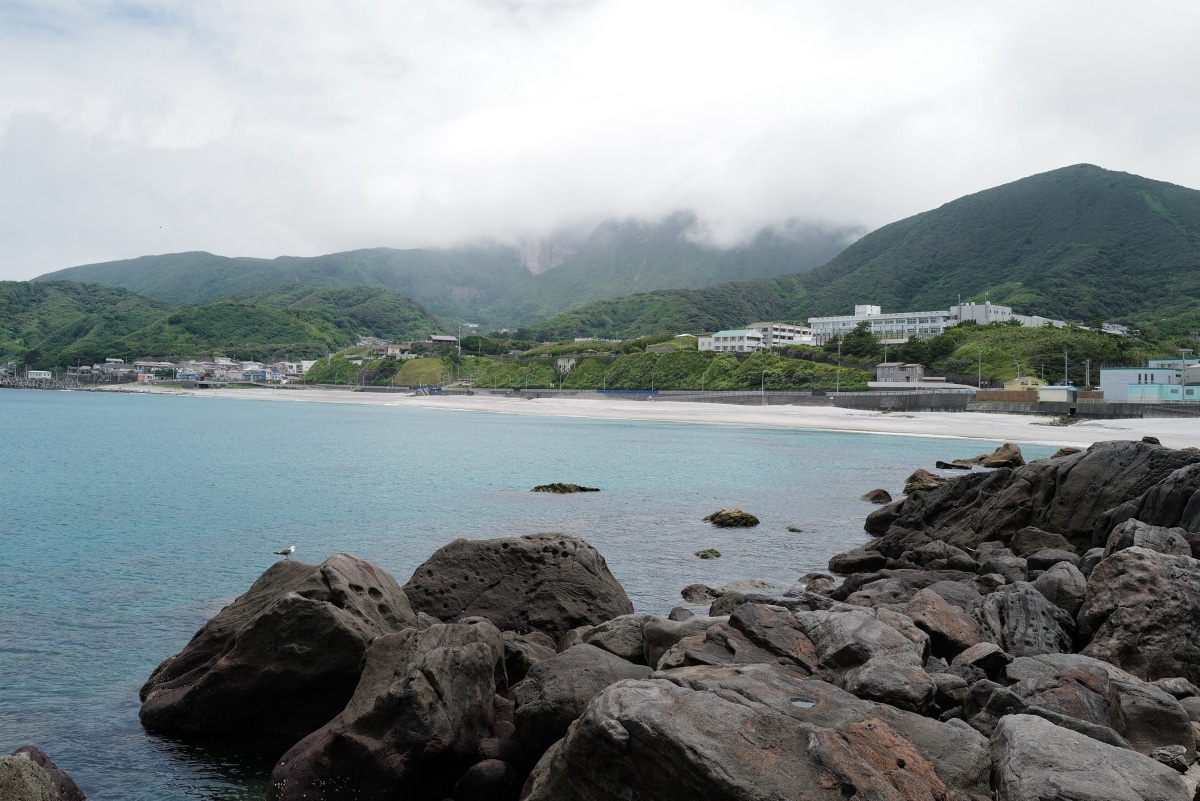
Looking back at the village of Kozushima
People have been coming to this island for a very long time. About 38,000 years ago, inhabitants of what is now the Izu Peninsula got into some kind of boat and crossed the ocean to reach here. Sea levels were lower then and the crossing probably shorter than the roughly 50km it is today, but it was still a long span of open sea. On a clear day, just as today, they would have seen the island from Izu and were presumably curious.
What they found was obsidian, a volcanic glass that fractures to an edge sharper than anything else that was available to stone-age toolmakers. The obsidian found at Palaeolithic sites on Japan’s mainland has been identified by chemical analysis as coming from Kozushima. It is assumed the people back then kept coming back for it, and their repeated crossings are now regarded by archaeologists as the oldest round-trip sea voyages in the world.
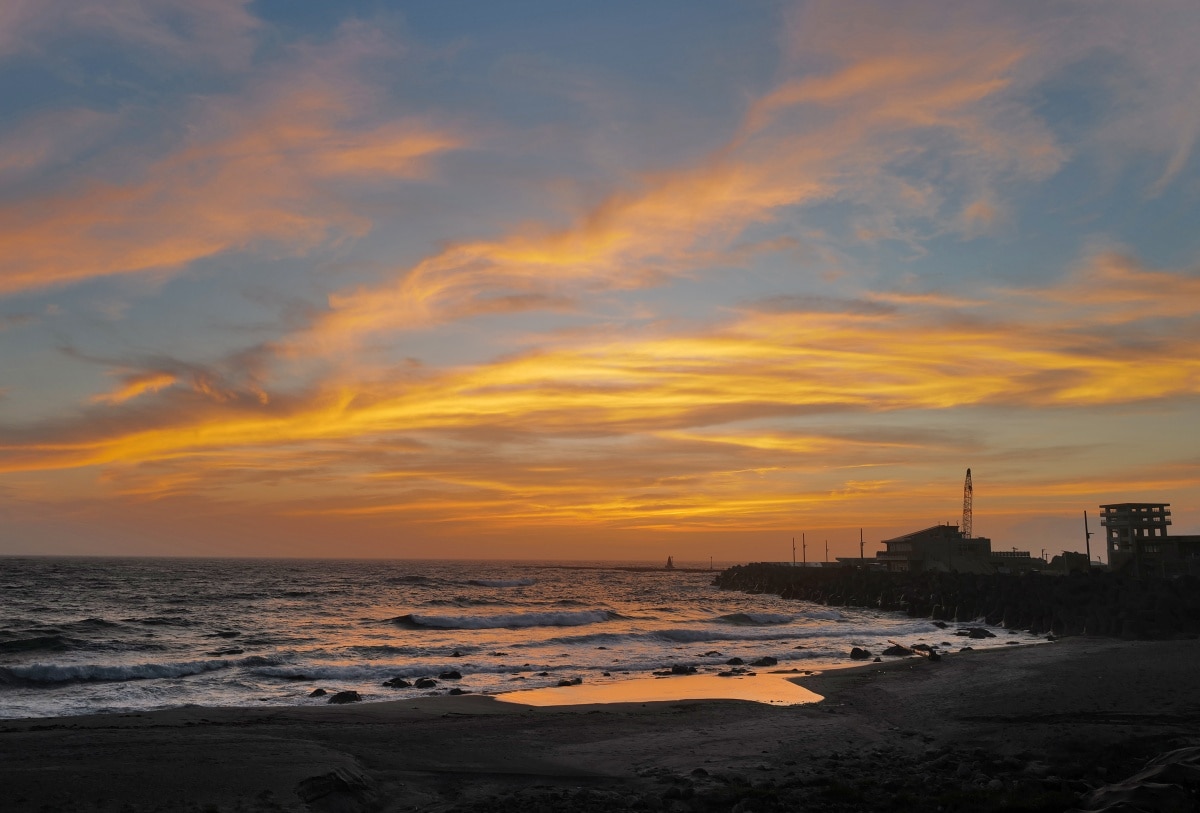
We may not have seen any stars but we saw some lovely sunsets/
It was mid-afternoon by the time we’d finished our out-of-season dip and we wandered through the small town, stopping at Hamakawa Meat Shop, a butcher popular for its beef croquettes and menchi katsu (minced-meat cutlet). We ate ours back at the minshuku, while we contemplated what to do for dinner. Accommodation and restaurants are rather limited on the island, and we soon learned booking is essential for most places.
Hyuga Brewery is a good fallback if everywhere else is full. We arrived as they opened at 5:30pm and let our toddler nap under the table. It’s the only craft brewery on the Izu Islands and its flagship beer, Angie, is a spice ale brewed with the island’s natural spring water and ashitaba (literally “tomorrow's leaf”), the bitter island green that grows all over the island. The menu also features an ashitaba pizza, smoked duck and cheeses, local fish rice, and a creamy pasta with Kozushima seaweed that had us wanting more.
We were waiting for dark. In December, 2020, Kozushima village was certified as an International Dark Sky Park, the first Tokyo island to be recognized as such. To qualify, the village had replaced the streetlights and security lights across the island with dark-sky-friendly fixtures. So, soon after dark, we walked about 15 minutes through the dimly-lit streets to Yotane Square park, which sits on high ground just above the village, and is the easiest of the island’s stargazing spots to get to.
In hindsight it would have been sensible to check the phase of the moon before we planned our trip. This had not occurred to me at all, until we were standing outside with a full moon coming and going behind the clouds, which meant that the few times the sky did clear, the moon simply washed the stars out.
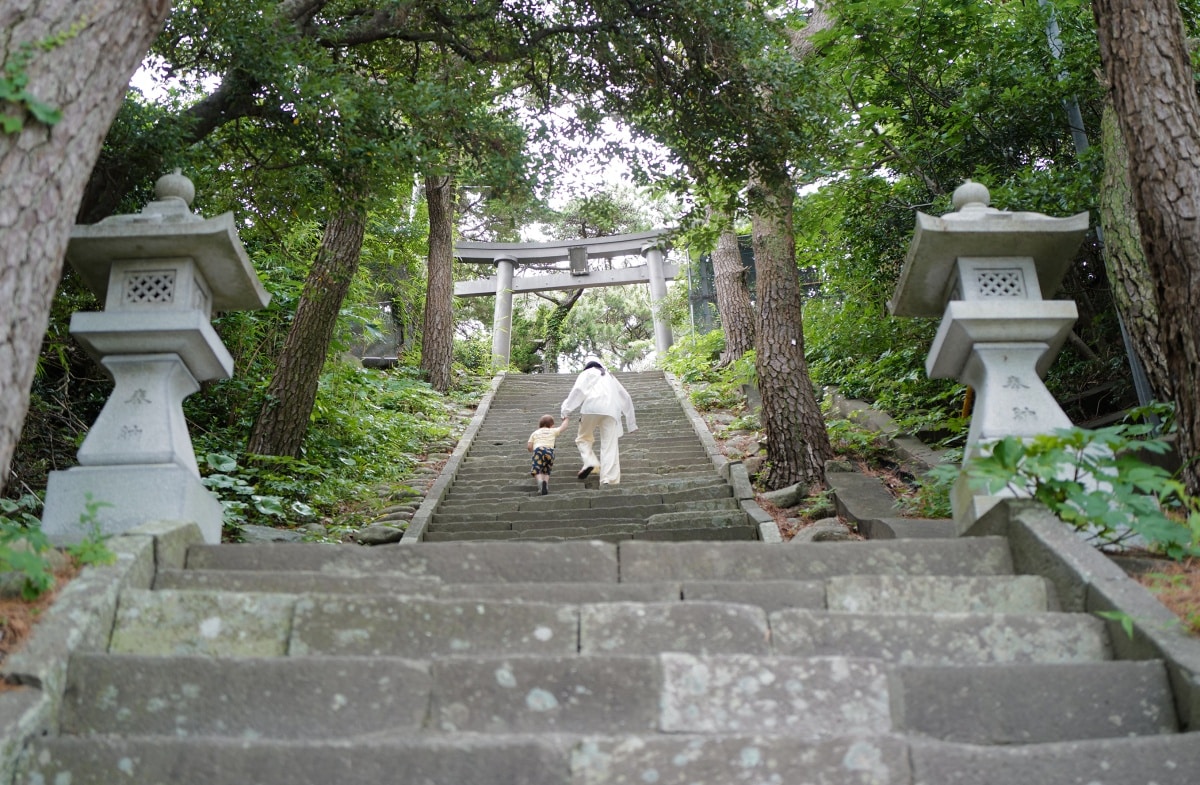
Early morning climb up the 88 steps of Monoimina-no-mikoto Jinja
After breakfast the next day, we climbed the 88 stone steps up through the trees to the Monoimina-no-mikoto Jinja nearby.
Then, back at the minshuku, we borrowed two electric bicycles, one with a child seat on the back, and a helmet they found for our son. We rode north out of the village along the coast road to Akasaki Promenade. On the way we stopped for lunch at the Kozushima Onsen Recreation Center, where I had the shima tendon (island tempura bowl), stacked with prawn, fish, eggplant, sweet potato and, of course, ashitaba.
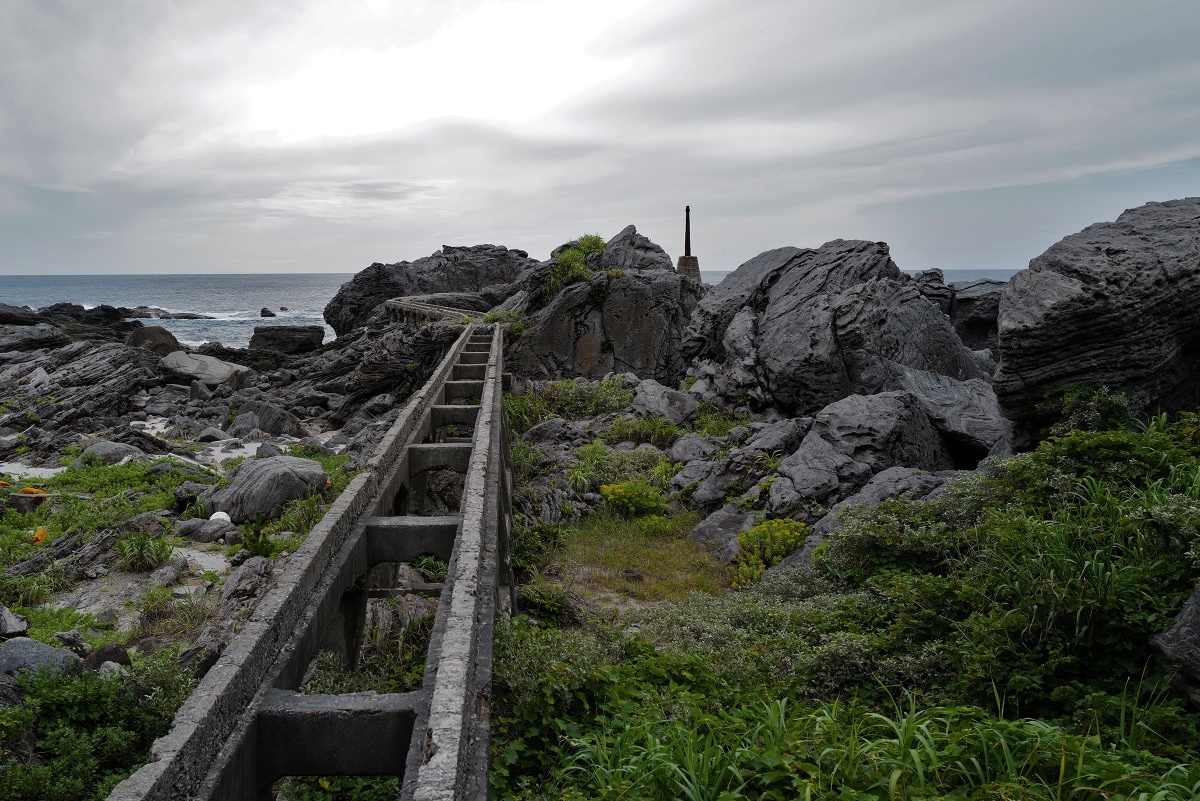
The trolley ruins at Nagumi Bay.
At Nagumi Bay we stopped to look at the ruins. During most of the Showa Era (1926-1989), Koga-ishi, a lightweight, pumice-like volcanic rock valued for being light, insulating and fire resistant, was quarried on Kozushima and shipped out as a building material. Stone from the quarries was moved down the mountain on a trolley line to the bay and the rails are still there, rusting into the scrub by the water.
At Akasaki, the promenade is a wooden boardwalk built along the cliffs, with bridges and diving platforms over the deep clear water. As our son and I watched from the boardwalk, my partner put on her snorkelling gear and jumped into the crisp clear water. Pretty soon she surfaced to say there were fish everywhere, including hamafuefuki (spangled emperor), mejina (largescale blackfish) and suzumedai (damselfish).
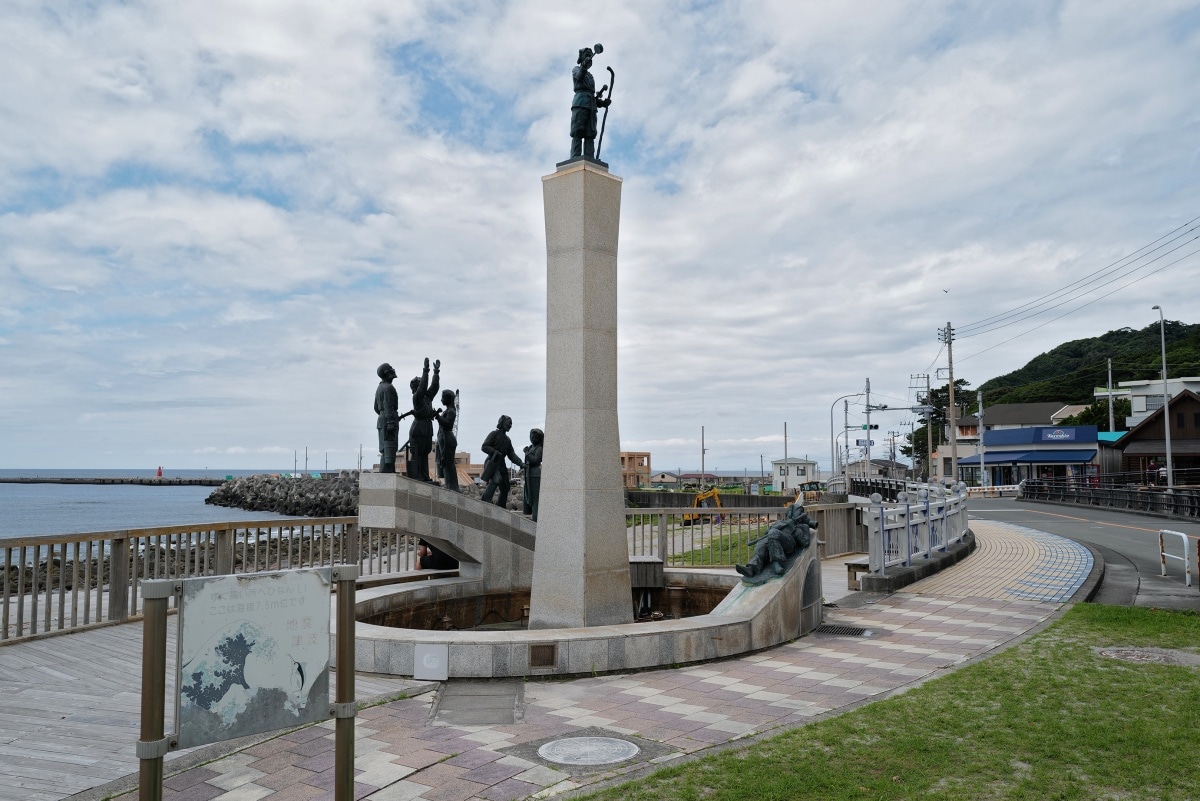
The Mizukubari Monument also known as the Statue of the Legend of Water Sharing.
On the way back to town we dropped into the onsen again, this time to bathe in the hot spring-water of the outdoor baths built into the rocks facing the sea. The spring water on Kozushima is literally the stuff of legend, and the island has an apparently endless supply.
The story goes that the gods of the Izu Islands met by a pond on the summit of Mount Tenjo to divide the water between them. The god of Toshima arrived last, found the pond nearly empty and angrily thrashed about in what was left, splashing the remaining water all over Kozushima. The dusty hollow where the pond is said to have been sits by a trail up Mount Tenjo and is now called Hairanaigasawa (the ravine no one enters). It is treated as sacred, and a sign nearby asks visitors not to set foot there.
More scientifically, rain that falls on Mt. Tenjo filters down through its volcanic rock and comes out as spring water, and the village draws its water from that groundwater. Two of the springs are on the metropolitan government’s list of Tokyo’s 57 notable spring waters, Takou Yusui (Tako Bay) and Tsuzuki Yusui inland below Tenjo. Islanders regularly fill empty bottles at both, and the local barley shochu, Moriwaka, is distilled with the water, while Hyuga Brewery’s beer is brewed with water from the Tsuzuki spring.
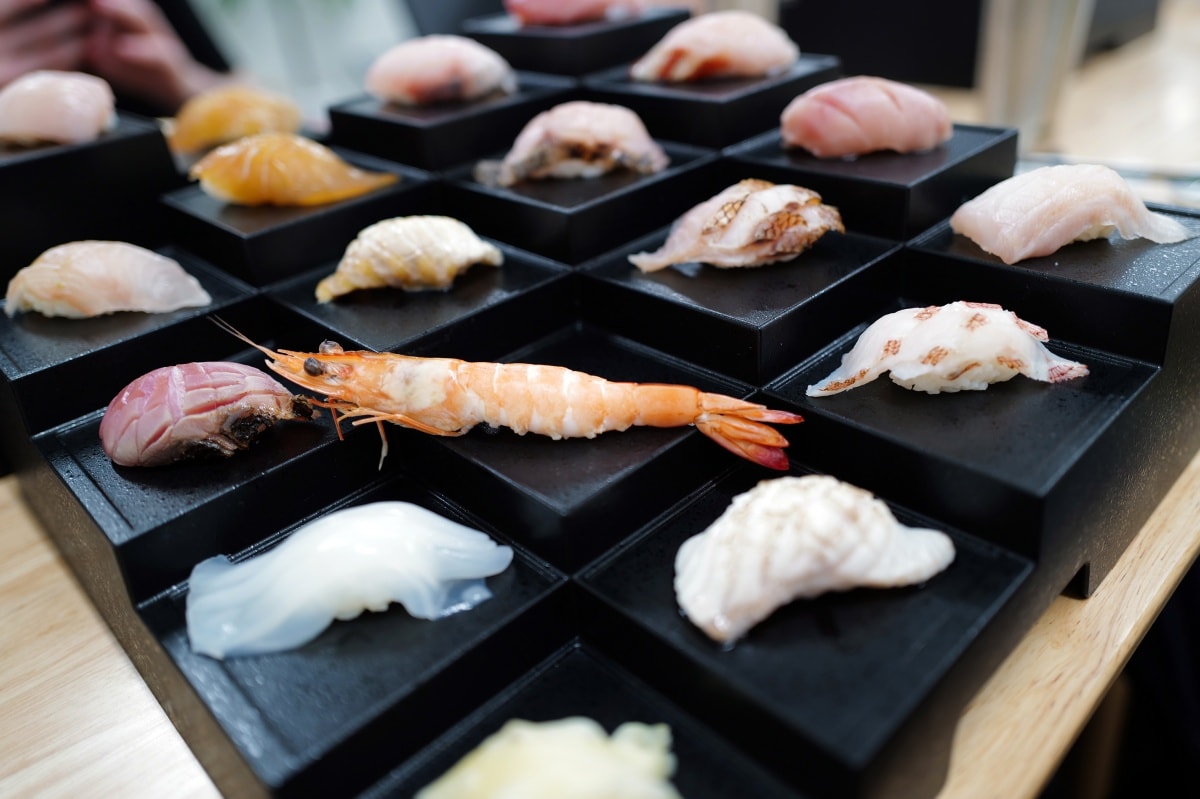
Aged fish sushi course at Jukuseigyo Kobo.
Back at the minshuku, we rested for a while before walking to Kozushima Jukuseigyo Kobo, a reservation-only sushi restaurant a couple of minutes walk from the harbour that specializes in aged fish. The chef ages the fish by carefully draining the blood out of the flesh, then leaving it to rest under controlled conditions for up to a few weeks. Ageing changes both the texture and the flavor. The flesh softens, the taste deepens into a rich umami and the sweetness comes forward.
The 15-piece nigiri course we had was arranged on a stepped display plate rather than being served a piece at a time. It featured isaki (chicken grunt), kanpachi (greater amberjack), bincho (albacore), ishidai (striped beakfish), and deep-water species you’d rarely find at a regular sushi joint such as sturgeon, aburabozu (skilfish), hanafuedai (snapper) and shimagatsuo (Pacific pomfret).
Nothing on the plate tasted like the fresh, just-caught sushi I’m used to, but the effect was subtle rather than funky or obviously “aged,” and each bite was incredible.
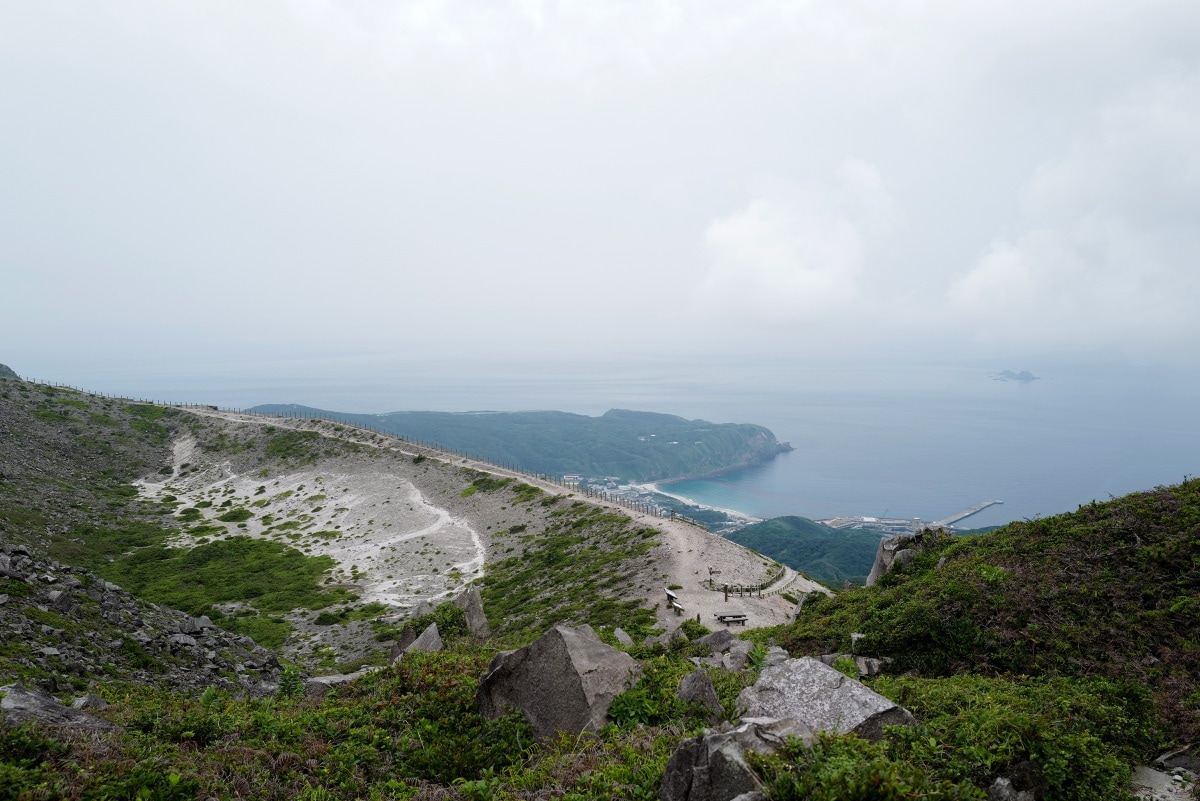
The view from Mount Tenjo with Hairanaigasawa to the left.
Hiking Mt. Tenjo, 572 meters, was next on our list of things to do. The summit is a plateau rather than a peak, with something like 40 low hills across it. The full crater circuit takes about five hours and crosses two white sand “deserts,” several ponds, with amazing sea views. There are two ways up the mountain, the Shiroshima trail and the Kuroshima trail. We rented a car and drove to the sixth station of the Shiroshima route. As we were getting out of the car, a couple came down off the trail and told us they had cut their walk short because of the mosquitoes.
Duly warned, we doused ourselves with bug spray and set off into the trees. Within minutes, we found it had no effect: we’d attracted what felt like the entire mosquito population of the island. I took the rear and waved my hat to keep the mozzies off our son. For a moment, I thought we should turn back, but the steep trail emerged from the trees onto the plateau of rock and low scrub, and the mosquitoes became more manageable.
The hollow at Hairanaigasawa sits by the junction where the Shiroshima trail from the carpark meets the main circular route. From there we turned left and headed to Fudoike, a small heart-shaped pond, and then up to Tenku no Oka (the Hill of the Sky), which on a clear day has views of the mainland and Mt. Fuji. Unfortunately, it was cloudy when we stopped there for lunch, but the sky cleared long enough for us to see the village and the white sand of Maehama beach below.
To get to the sandy deserts that were supposed to be the highlight of the hike, we realized we’d have to enter bug-infested scrub again. So, with our toddler desperately needing a nap, we decided to turn round at Tenku no Oka and return the way we had come.
That evening we got a private room at Ryugu, an izakaya with a menu that leans heavily on local fish, from sashimi and sushi to grilled and simmered dishes. I had a delicious kinmedai, which was rich in fat and simmered in sweet-salty nitsuke sauce.
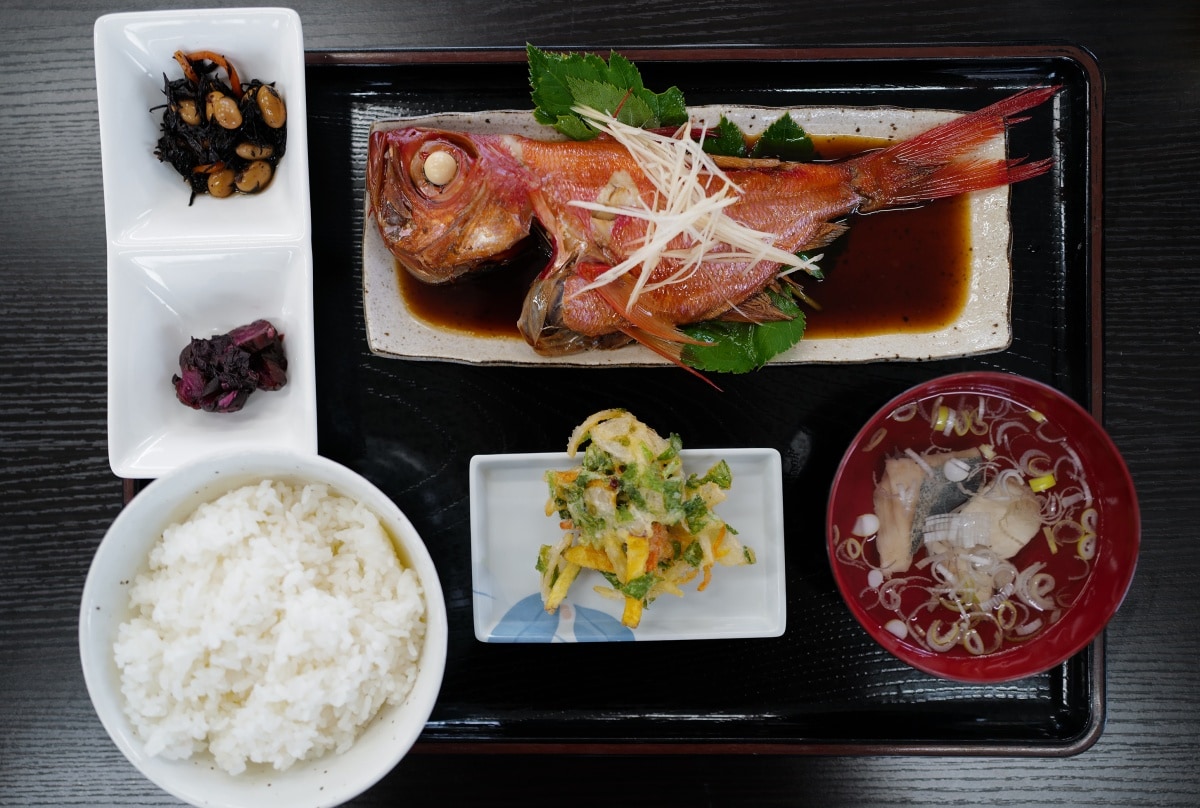
The set lunch with whole kinmedai at the Yocchaare Center by the port.
The minshuku we stayed in, Shimayado Hamanoya, was a great find for anyone with small children. It has been open since 1962, and is only a few minutes from the port. There is a box of toys in the common room and the family’s young daughter seemed used to visiting kids playing with them. This was a bonus on our fourth day, as it rained and we were stuck inside for while.
Another good rain activity is the Kozushima Local History Museum where we learned about the culture of the island and its Palaeolithic roots, and examined the several large lumps of obsidian on display.
Lunch was at the shokudo run by the fishing co-operative on the second floor of the Yocchaare Center by the port. They serve whatever is in that morning's catch but the set lunch with a whole kinmedai is their specialty. They make a limited number each day and when they are gone they are gone.
Our bad luck with the weather continued: our flight home was cancelled, which meant an extra night on the island. We had no luck booking dinner, so we went back to the brewery for the cream pasta. Later, when our lad was asleep, I slipped out to see if I’d have better luck with the stars. Foiled by the clouds again, I dropped into Animet, a snack bar near the minshuku, for a nightcap. The mama-san who welcomed me was the woman with the poodle and recognized me from the beach on our first day. Summer was offically under way now, and a couple from Okinawa, still wearing their beach clothes, sang a song about the ocean.
We left the next morning on the jet boat, feeling a little disappointed that we hadn’t finished the Mt. Tenjo hike or seen the star-filled sky we’d expected to see. So one day we’ll go back, when the clouds are gone and the moon is dark.
I'm a writer now, but have been a jack of all trades when it comes to publishing, including designer, editor, and creative director. I was at The Japan Times newspaper for 10 years, which I rebranded and redesigned in 2017. Since leaving the JT, I've been studying wine and I am currently doing the WSET Diploma. The main focus of my writing these days is the wine of Japan.
andrewlee.jp