Cycling the Arakawa: A River Runs Through Tokyo
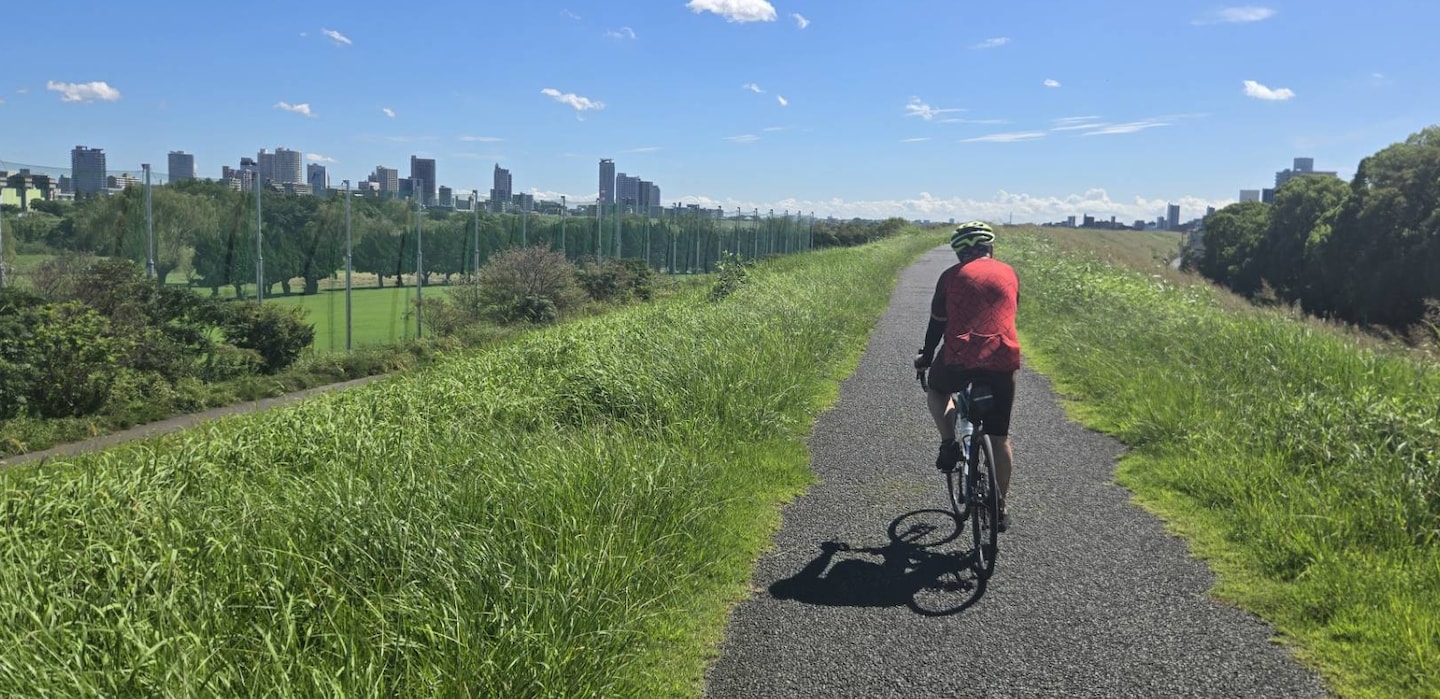
Join a father and son as they ride along the Arakawa River, from Tokyo’s eastern edge to riverside parks, lakes, farms and a much-loved gelato stop. Mark Schilling, a dedicated cyclist, describes one of his favorite routes.
By Mark SchillingCyclists in Tokyo come in two varieties: The millions who pedal for strictly utilitarian purposes—to go to the station or pick up the kids—and the smaller but still substantial number who actually enjoy riding. Once in the former group I am now firmly in the latter.
A big reason are the many bike paths that crisscross the city and neighboring prefectures. Instead of breathing exhaust fumes and having close encounters with trucks, I can ride in peace and safety along rivers and canals or under canopies of trees.
The biggest, and in some ways best, Tokyo bike path is the Arakawa Cycling Road, which begins where the Arakawa River, 500 meters wide, empties into Tokyo Bay. It extends far into the countryside, with the terminus being in the city of Kumagaya, though there is also a path to nearby Musashi Kyuryo National Forest Park. Almost no one, however, rides its 150- or 160-kilometer length in one go.
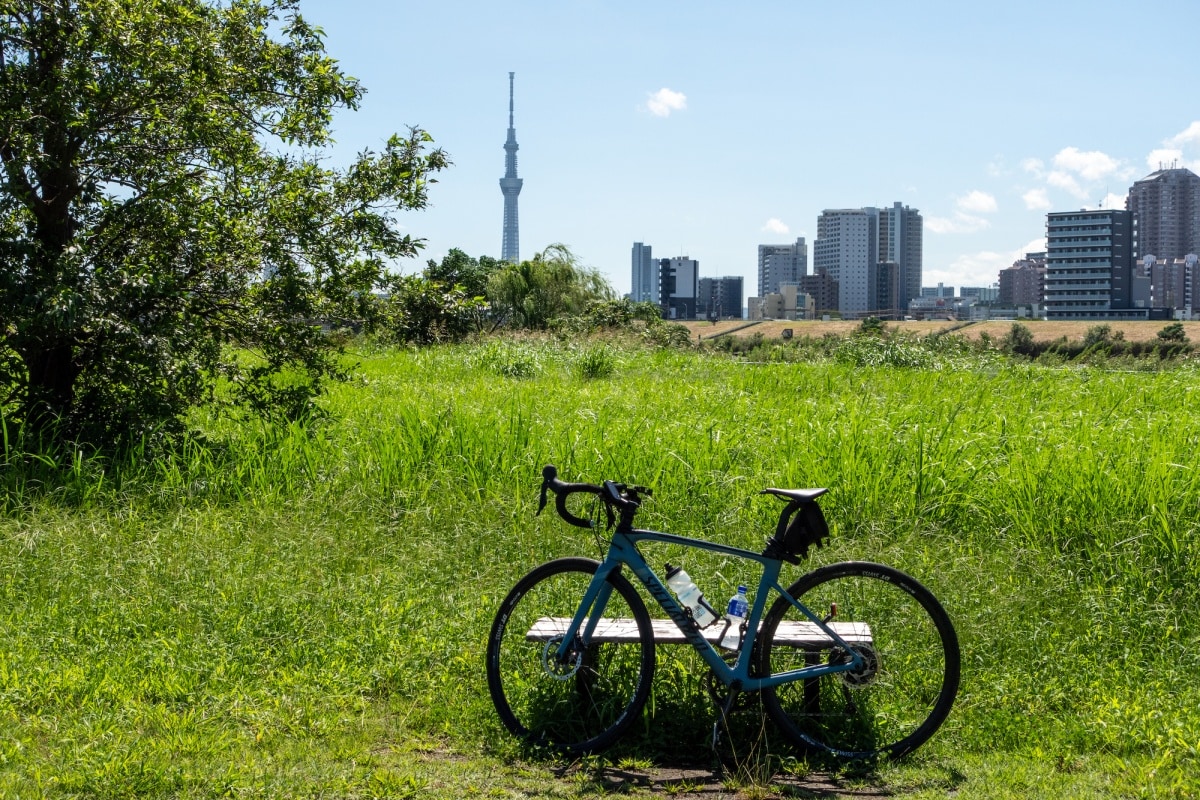
A view of Skytree from the north side of the Arakawa Cycling Road.
My starting point to the Arakawa is just outside my front door in Higashi Kurume—a paved cycling path that winds along the Ochiaigawa River and continues after the Ochiaigawa joins the larger Kuromegawa River. After riding ten kilometers, I leave the by now broken and gravelly path and take surface roads for five more kilometers to where the Shingashi River flows into the Arakawa, 31 kilometers from Tokyo Bay.
On a Monday in mid-September—the first calm, sunny day after weeks of typhoon rain and wind—I rode out to the Arakawa and eight kilometers east on the cycling road to meet my son Ray at a Family Mart convenience store near the Route 17 bridge. We have often cycled together in Japan and elsewhere, including England, Ireland, Italy and Croatia, but the Arakawa is our most frequent joint ride and the store our usual meeting place.
Unlike Tokyo cycling paths that require weaving past barriers, stopping for traffic lights and slowing for crowds of pedestrians, the Arakawa Cycling Road is largely unobstructed and, at its widest, is more like a two-lane highway than a bike path. It is also flat, though climbs up its massive embankments can be steep, if short.
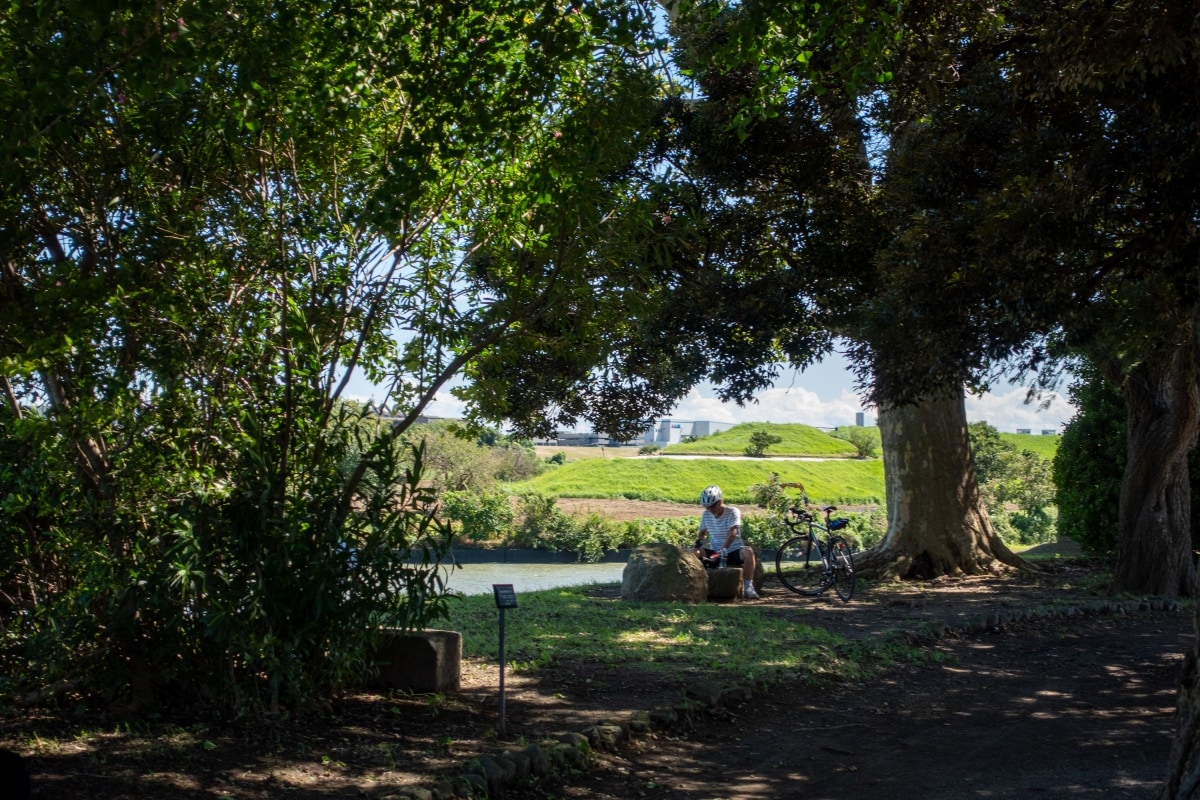
Taking a break at Nakanoshima. The Arakawa is in the background.
The path attracts lycra-clad speedsters who think they are time trialing at the Tour de France, but there is also plenty of room for slower cyclists, us included. Also, on our Monday ride, the runners, golfers, baseball players and others that flock to the river on weekends were relatively few.
We headed east on the south side of the river about five kilometers to the Iwabuchi Watergates – two giant locks, one blue and one red for its red brick construction. Located where the Sumida River flows from the Arakawa, they were built for flood control, though the red one is no longer in service.
Near the red lock is Nakanoshima, a tiny island, accessible by bridge, where we stopped to enjoy a wide-angle view of the river from tree-shaded stone seats. The locks also overlook a riverside park that is filled with picnickers and their barbeque grills on weekends but we found deserted save for a couple of fishermen.
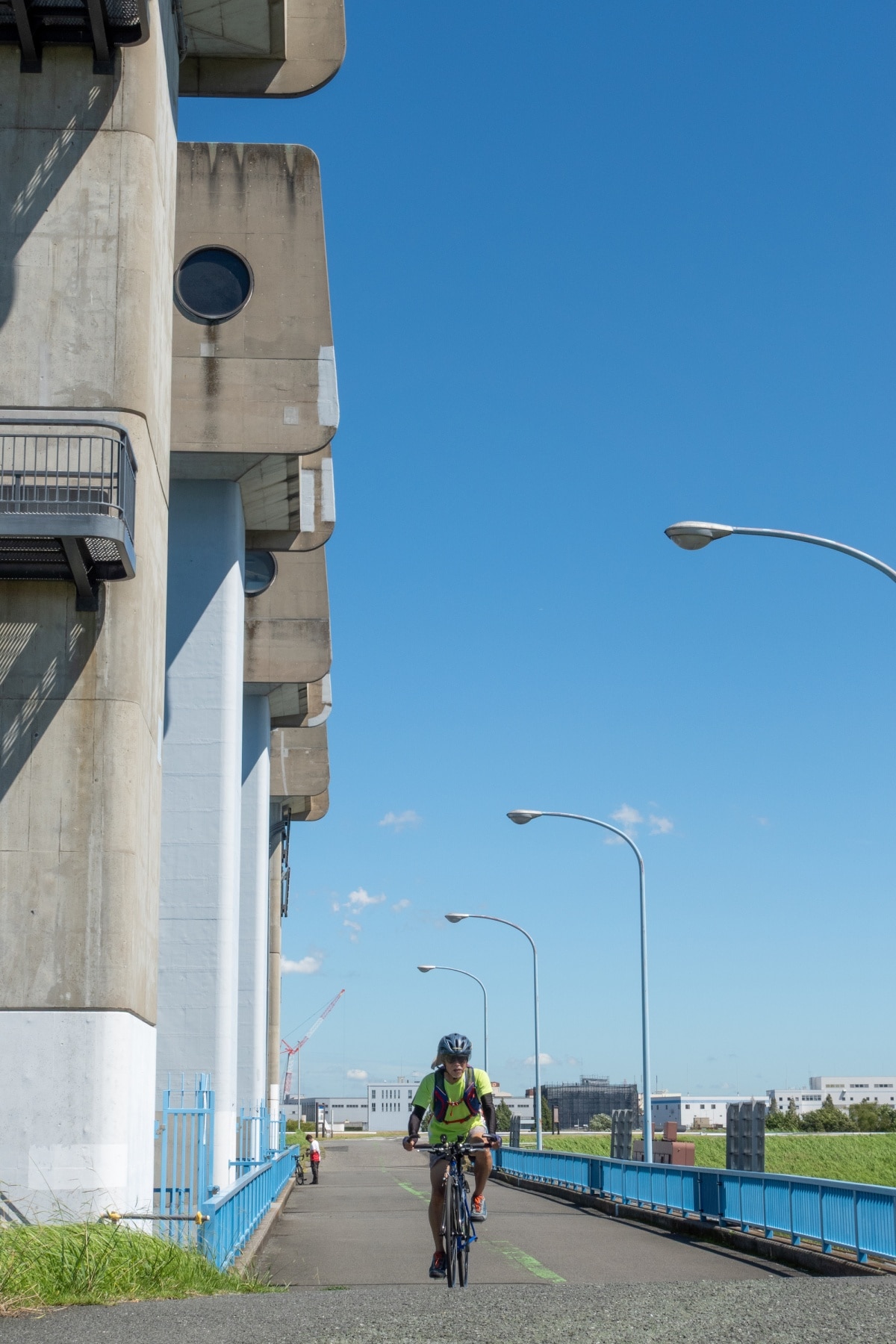
Towards the bay from the blue lock we could see Tokyo Skytree, the 634-meter broadcasting and observation tower that has dominated the Tokyo skyline since opening in 2012. It has also appeared in many films including the 2023 Wim Wenders hit Perfect Days, whose toilet cleaner protagonist, played by Koji Yakusho, lives in its shadow.
The Arakawa River itself can be glimpsed in countless Japanese TV dramas and movies. One is the 1953 Yasujiro Ozu masterpiece Tokyo Story, in which the grandmother played by Chieko Higashiyama walks with her young grandson on an Arakawa levee.
More recent is Arakawa Under the Bridge, the 2012 Ken Iizuka dramedy, based on a popular manga, whose homeless heroine played by Mirei Kiritani saves Kento Hayashi’s stressed company man from downing and introduces him to oddball characters living in an encampment on the title river.
Real homeless people shelter under the Arakawa’s bridges and also live close to the river, which puts them in danger when it rises, as it has many times in the past. Near Nakanoshima we spotted a marker in the water inscribed with the Arakawa’s highest recorded level, 8.6 meters, reached during Typhoon Kathleen in September 1947.
Since then, flood control measures have mostly kept the river from destructively overflowing its banks, but a series of typhoons this summer and fall turned baseball fields and bike paths into lakes.
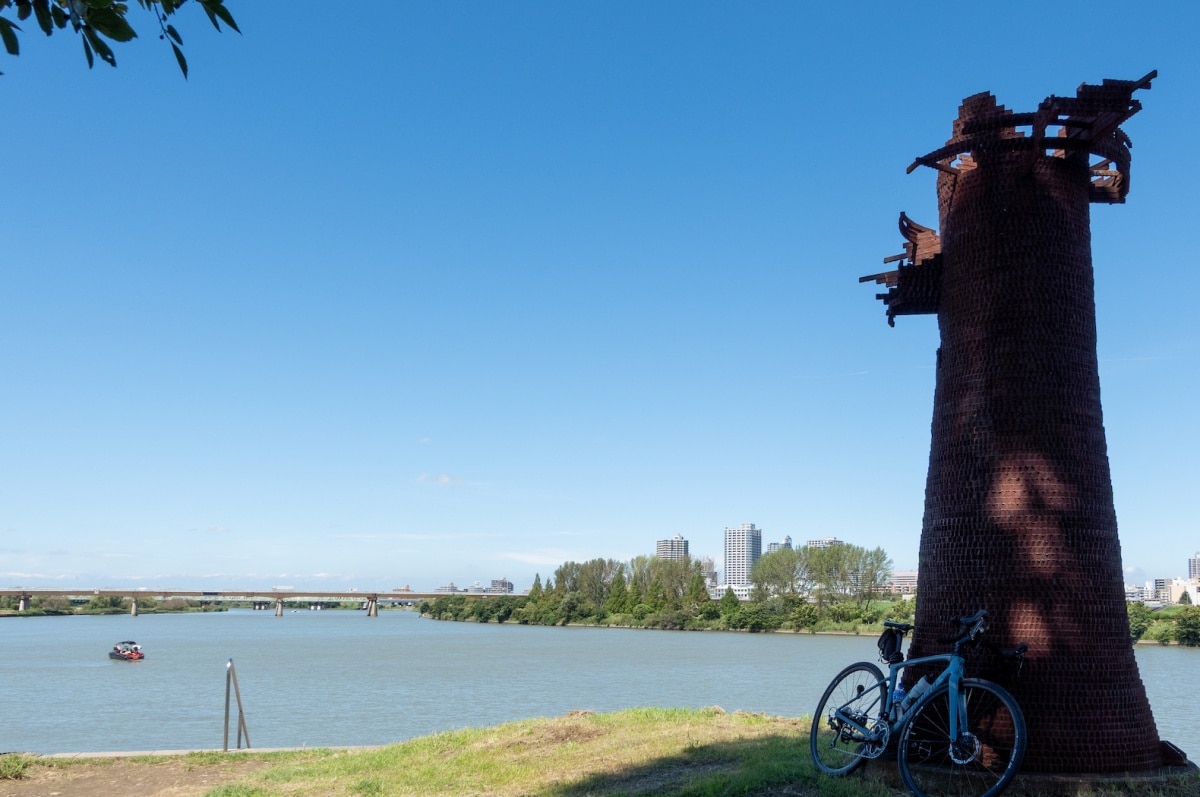
View of the Arakawa from "Shooting the Moon" (Tsuki wo Iru), a sculpture by Tadashi Aono on Nakanotshima. The material is Riverten steel -- a type of steel designed to rust naturally over time.
On our Monday ride, however, we met with only a few scattered puddles. As we crossed to the north side of the river and kept pedaling east, Skytree loomed ever larger, until we arrived at its closest point from the cycling road, by the Route 319 bridge. On previous rides we had pushed on against head winds another ten kilometers to the path’s end, where we had a panoramic view of the bay.
We also had made side trips to nearby Kasai Rinkai Park, whose attractions include a Ferris wheel, aquarium and bird sanctuary. Just east of the park, over the Maihama Ohashi Bridge, is Tokyo Disneyland, but that’s one ride we have yet to do.
Ray, who is a director for the Tokyo branch of a US cable and satellite network, had work waiting, so we turned around and rode ten kilometers west to Kitchen Toretate, a rest stop and light-meal cafe on the river’s north side that caters to cyclists. There we had a late lunch and Toretate’s specialty—scrumptious soft-serve ice cream in flavors that change with the season.
After a short ride to the Shinarakawa Ohashi bridge, we crossed over to the south bank and headed west again. We parted company on the cycling road not far from where we had met and I pedaled home, for a total ride of 82 kilometers.
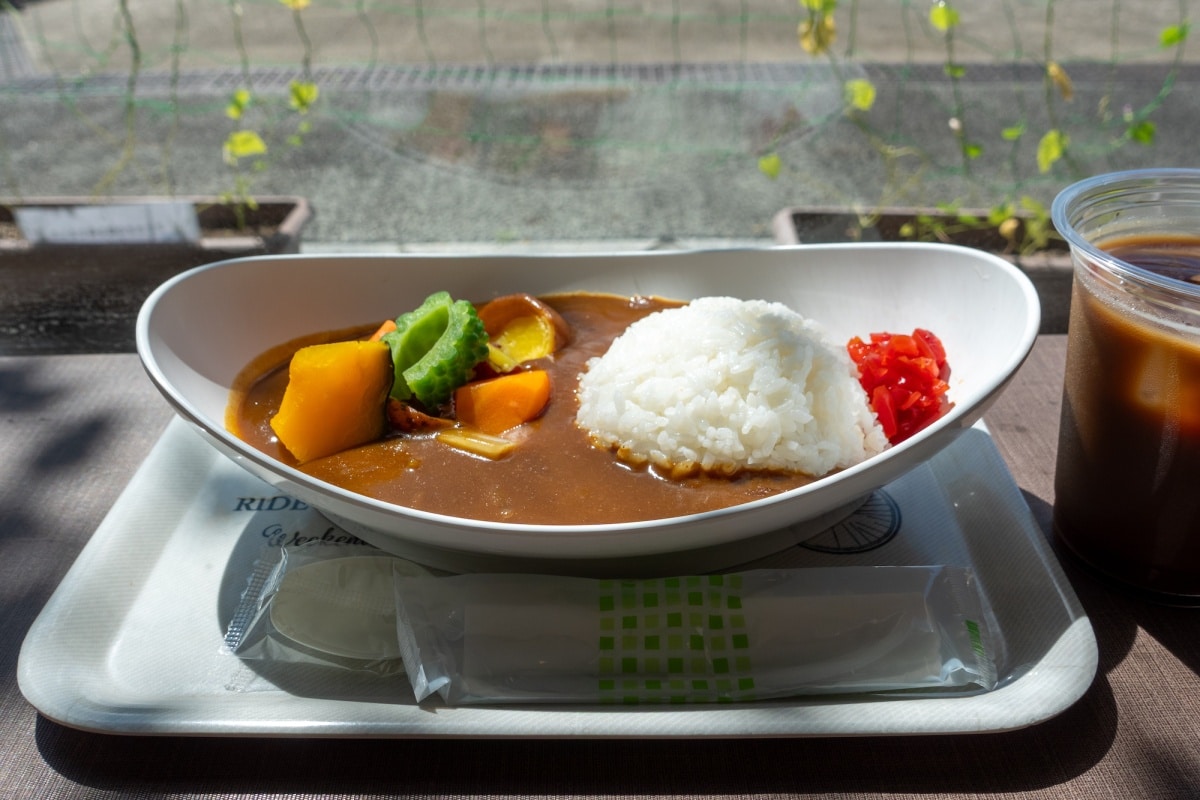
Curry at the Toretate rest stop on the north bank of the Arakawa. Filling and delicious, it's a popular choice of hungry cyclists.
If we had had a bit more time, we could have extended our trip a few kilometers to Lake Saiko, a large manmade lake in Saiko Doman Green Park that attracts hundreds of ducks, coots and other water birds in the winter and, in the summer, windsurfers and day trippers, who set up tents near its banks. Thirty kilometers from the bay on the north-side bike path, the lake is a frequent stop of mine, but on a weekday in early fall, it would have been nearly empty of both people and wildlife.
West of Lake Saiko, past the city of Saitama and into the countryside, the bike path becomes trickier to follow or, save for weathered directional signs, seems to disappear altogether. But about 20 kilometers from the lake a delicious destination awaits: Enomoto Dairy Farm, a small working farm next to the Arakawa’s north bank that sells freshly made gelato from a small onsite shop with a counter and tables.
Enomoto also has a barn and cages where visitors can view cows, pigs and chickens. Their fragrance, however, wafts over to the nearby picnic tables, making it advisable to eat back near the bike racks or inside the shop, especially on hot days when the air conditioning provides welcome relief.
The dairy is the turn-around point for most cyclists. For me it is 70 kilometers out and back, which is usually enough riding for one day. But I have ventured beyond, cycling on both sides of the river, as well on its branches and sub-branches that wind through the Kanto Plain.
From Kumagaya, where the Arakawa Cycling Road terminates, I’ve headed west to the Chichibu hills or north to the Tonegawa River. There I’ve picked up the Tonegawa Cycling Road, which extends 220 kilometers from the ocean port of Choshi to the city of Shibukawa in Gumma Prefecture.
On these and other longer rides, I’ve sometimes reached the century (100-mile or 161-kilometer) mark, but I’m usually on the Arakawa for its feeling of open-air freedom, not personal distance records.
In other words, for me it’s the journey –and the gelato.
Tips for riding the Arakawa Cycling Road
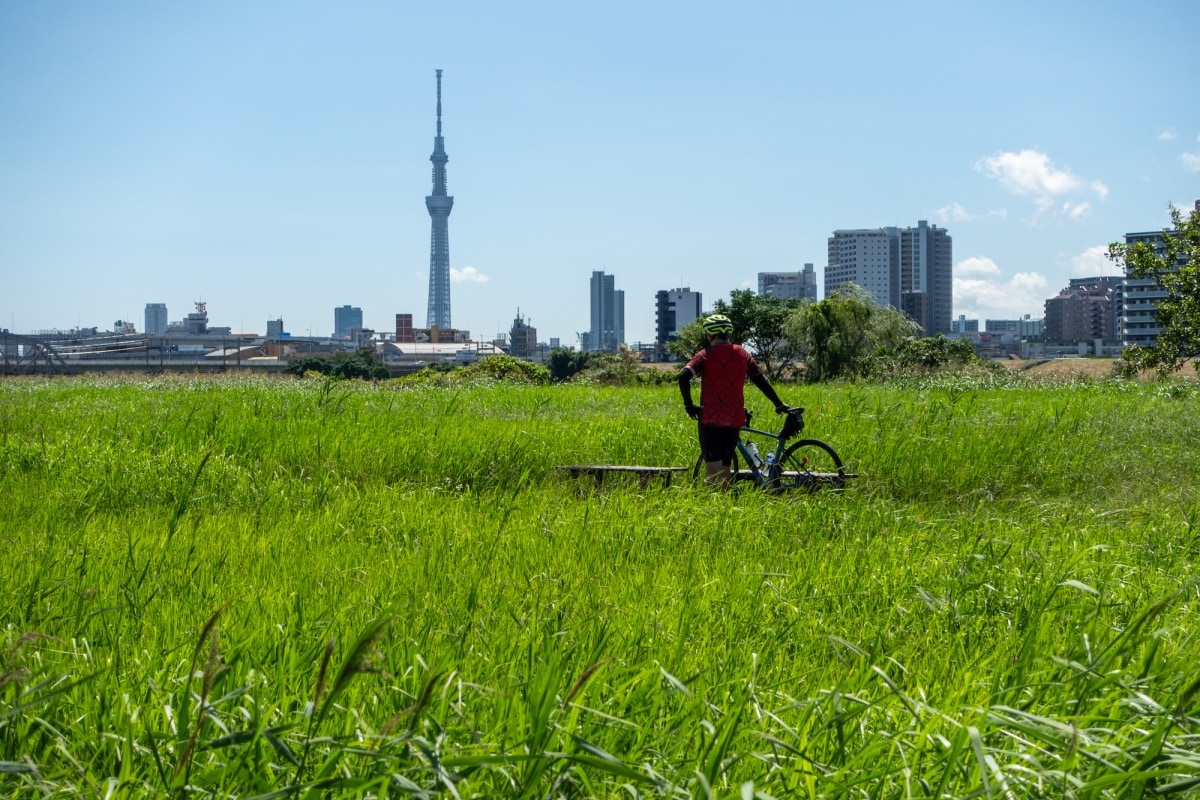
Contemplating Skytree not far from its closest point to the Arakawa, where it is about a 20-minute ride away.
1) If the weather looks threatening, bring a poncho: For long stretches of the path, bridges are just about the only shelter and in a downpour the ride to the next one can be a long, soaking-wet slog.
2) Toilets and drinking water can be found in the many parks, baseball fields and other recreational facilities on both sides of the river. In the colder months of the year, however, the drinking fountains are shut off and chains and locks appear on the toilets.
3) Slow down when passing a baseball game or soccer practice: A ball might bounce into front of your wheel or you might have to dodge the kid chasing it. Set speed records on Strava when the fields and pitches are empty.
4) If you are planning a long ride, bring the rinko bag that is required for transporting bikes on trains. If you forget your poncho and are on the verge of hypothermia in a cold driving rain, that bag can be a life saver. Take it from one who knows.